


Godfather Death - Brothers Grimm
Godfather Death
A fairy tale by the Brothers Grimm
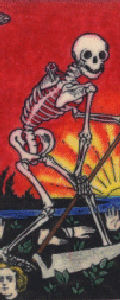
A poor man had twelve children and had to work day and night in order just to feed them. Thus when the thirteenth came into the world, not knowing what to do in his need, he ran out into the highway, intending to ask the first person whom he met to be the godfather. The first person who came his way was our dear God, who already knew what was in his heart, and God said to him, "Poor man, I pity you. I will hold your child at his baptism, and care for him, and make him happy on earth." The man said, "Who are you?" - "I am God." - "Then I do not wish to have you for a godfather," said the man. "You give to the rich, and let the poor starve." Thus spoke the man, for he did not know how wisely God divides out wealth and poverty. Then he turned away from the Lord, and went on his way. Then the devil came to him and said, "What are you looking for? If you will take me as your child's godfather, I will give him an abundance of gold and all the joys of the world as well." The man asked, "Who are you?" - "I am the devil." - "Then I do not wish to have you for a godfather," said the man. You deceive mankind and lead them astray." He went on his way, and then Death, on his withered legs, came walking toward him, and said, "Take me as your child's godfather." The man asked, "Who are you?" - "I am Death, who makes everyone equal." Then the man said, "You are the right one. You take away the rich as well as the poor, without distinction. You shall be my child's godfather. Death answered, "I will make your child rich and famous, for he who has me for a friend cannot fail." The man said, "Next Sunday is the baptism. Be there on time." Death appeared as he had promised, and served as godfather in an orderly manner.
After the boy came of age his godfather appeared to him one day and asked him to go with him. He took him out into the woods and showed him an herb that grew there, saying, "Now you shall receive your godfather's present. I will turn you into a famous physician. Whenever you are called to a sick person I will appear to you. If I stand at the sick person's head, you may say with confidence that you can make him well again; then give him some of this herb, and he will recover. But if I stand at the sick person's feet, he is mine, and you must say that he is beyond help, and that no physician in the world could save him. But beware of using this herb against my will, or something very bad will happen to you."
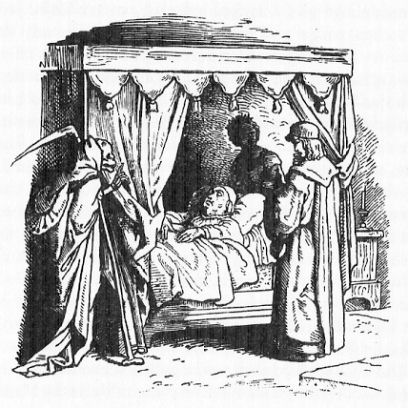
It was not long before the young man had become the most famous physician in the whole world. People said of him, "He only needs to look at the sick in order to immediately know their condition, whether they will regain their health, or are doomed to die." And people came to him from far and wide, taking him to their sick, and giving him so much money that he soon became a wealthy man. Now it came to pass that the king became ill. The physician was summoned and was told to say if a recovery were possible. However, when he approached the bed, Death was standing at the sick man's feet, and so no herb on earth would be able to help him. "If I could only deceive death for once," thought the physician. "He will be angry, of course, but because I am his godson he will shut one eye. I will risk it." He therefore took hold of the sick man and laid him the other way around, so that Death was now standing at his head. Then he gave the king some of the herb, and he recovered and became healthy again. However, Death came to the physician, made a dark and angry face, threatened him with his finger, and said, "You have betrayed me. I will overlook it this time because you are my godson, but if you dare to do it again, it will cost you your neck, for I will take you yourself away with me."
Soon afterward the king's daughter became seriously ill. She was his only child, and he cried day and night until his eyes were going blind. Then he proclaimed that whosoever rescued her from death should become her husband and inherit the crown. When the physician came to the sick girl's bed he saw Death at her feet. He should have remembered his godfather's warning, but he was so infatuated by the princess's great beauty and the prospect of becoming her husband that he threw all thought to the winds. He did not see that Death was looking at him angrily, lifting his hand into the air, and threatening him with his withered fist. He lifted up the sick girl and placed her head where her feet had been. Then he gave her some of the herb, and her cheeks immediately turned red, and life stirred in her once again.
Death, seeing that he had been cheated out of his property for a second time, approached the physician with long strides and said, "You are finished. Now it is your turn." Then Death seized him so firmly with his ice-cold hand that he could not resist, and led him into an underground cavern. There the physician saw how thousands and thousands of candles were burning in endless rows, some large, others medium-sized, others small. Every instant some died out, and others were relit, so that the little flames seemed to be jumping about in constant change. "See," said Death, "these are the life-lights of mankind. The large ones belong to children, the medium-sized ones to married people in their best years, and the little ones to old people. However, even children and young people often have only a tiny candle." - "Show me my life-light," said the physician, thinking that it still would be very large. Death pointed to a little stump that was just threatening to go out, and said, "See, there it is." - "Oh, dear godfather," said the horrified physician, "light a new one for me. Do it as a favor to me, so that I can enjoy my life, and become king and the husband of the beautiful princess." - "I cannot," answered Death. "One must go out before a new one is lighted." - "Then set the old one onto a new one that will go on burning after the old one is finished," begged the physician. Death pretended that he was going to fulfill this wish and took hold of a large new candle, but, desiring revenge, he purposely made a mistake in relighting it, and the little piece fell down and went out. The physician immediately fell to the ground, and he too was now in the hands of Death.
* * * * *


Fairy taleBrothers Grimm

Translations:
Compare two languages:


